

Launching a digital product starts with an idea, but turning that idea into a successful product requires more than simply building features. Many startups fail because they spend months developing complex solutions before understanding what users actually need.
This is where defining a minimum viable product (MVP) becomes essential. An MVP helps founders test their product idea, validate assumptions, collect user feedback, and build a foundation for future growth. Instead of investing heavily in unnecessary features, startups can focus on creating a product experience that solves a real problem.
A strong MVP strategy combines product research, user understanding, feature prioritization, and a clear development roadmap.
What Is an MVP?
A Minimum Viable Product (MVP) is the first version of a digital product that includes only the essential features required to solve a user’s primary problem. However, an MVP is not simply a smaller version of the final product. It is a strategic approach that helps businesses understand:
- Whether users actually need the product
- Which features create the most value
- How customers interact with the solution
- What improvements should be prioritized next
For startups, an MVP reduces development risks by allowing teams to validate ideas before investing significant time and resources.
Why Defining an MVP Matters for Startups
Many founders begin product development by focusing on features they believe users want. However, without proper validation, this approach often leads to wasted resources and complicated products. A well-defined MVP helps startups
Reduce Development Costs
Building every possible feature from the beginning increases development time and expenses. An MVP allows teams to focus on the features that deliver the highest business impact.
Validate Product-Market Fit
Before scaling a product, startups need evidence that users actually find value in the solution. An MVP provides real-world feedback that helps refine the product strategy.
Create a Clear Product Roadmap
A structured MVP process helps founders understand what should be built first and what can be developed later.
Improve User Experience
By focusing on essential user needs, startups can create simpler and more intuitive product experiences.
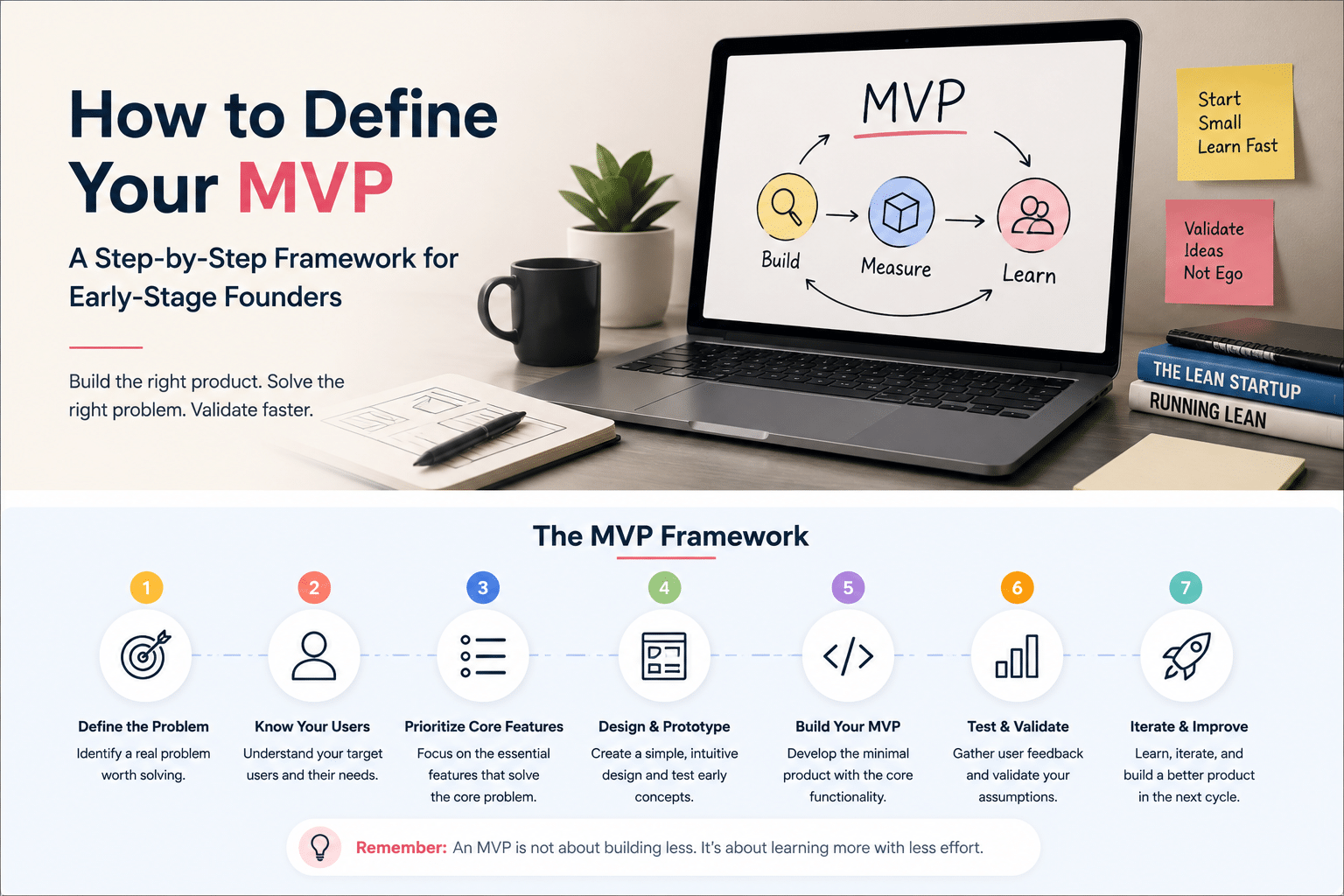
The Step-by-Step Framework to Define Your MVP
Step 1: Identify the Core Problem Your Product Solves.
Before deciding features, define the problem. A successful product does not start with “What features should we build?” It starts with “What problem are we solving for our users?” Founders should clearly identify:
- Who is facing this problem?
- How are users currently solving it?
- What challenges exist with current solutions?
- Why would users choose a better alternative?
Understanding the user problem creates the foundation for effective product strategy.
Step 2: Define Your Target Users
An MVP should focus on a specific audience rather than trying to serve everyone. Create a clear user profile by identifying:
- User demographics
- Professional roles
- Goals and motivations
- Pain points
- Existing behaviour patterns
For example, a B2B SaaS product designed for enterprise teams will have different MVP requirements compared to a consumer mobile application. Understanding users helps teams create relevant user journeys and better product experiences.
Step 3: Prioritize Features Based on User Value
Feature prioritization is one of the most important stages of MVP development. A common mistake founders make is adding too many features because they believe more functionality creates more value. Instead, classify features as follows:
Must-Have Features
These are essential features required for the product to solve the main user problem.
Should-Have Features
These improve the experience but are not necessary for the initial launch.
Future Features
These can be considered after validating the MVP with real users. A strong MVP focuses on solving one important problem effectively rather than solving multiple problems poorly.
Step 4: Create User Flows and Product Structure
Once the core features are identified, the next step is designing how users interact with the product. This includes:
- User journey mapping
- Information architecture
- User flows
- Wireframes
- Prototype creation
A strong product design process ensures that the MVP is not only functional but also easy to use. At this stage, UX/UI design plays an important role in transforming ideas into practical digital experiences.
Step 5: Build a Prototype and Validate the Idea
Before moving into full development, startups should test their product concept. A prototype helps founders:
- Understand user behaviour
- Identify usability issues
- Collect early feedback
- Improve product decisions
Testing early prevents expensive changes during development. This validation process is a critical part of software product design because it ensures the final product aligns with user expectations.
Step 6: Create an MVP Development Roadmap
After validation, teams can create a structured development plan. A good MVP roadmap should include the following:
- Required features
- Development timeline
- Technical requirements
- Testing process
- Future improvement plans
This roadmap connects product strategy with execution and ensures teams move toward measurable business goals.
Common MVP Mistakes Startups Should Avoid
Building Too Many Features, A complicated MVP increases development time and makes it difficult to understand what actually creates value.
Ignoring User Feedback
An MVP should evolve based on real user behavior, not assumptions.
Focusing Only on Technology
Technology is important, but the product must first solve a meaningful user problem.
Skipping Product Design
Poor UX can prevent users from adopting even a technically strong product.
How Bokaap Helps Startups Build Effective MVPs
Building an MVP requires alignment between strategy, design, and development. At Bokaap Design, we help startups move from idea validation to market-ready digital products through a structured product development process. Our approach combines:
- Product strategy
- User research
- UX/UI design
- Prototype validation
- End-to-end product development
By connecting strategy and execution, startups can avoid unnecessary development costs and build products that are designed for scalability.
Frequently Asked Questions
What is the purpose of an MVP?
An MVP helps startups test their product idea, validate user demand, and identify the most valuable features before investing in full-scale development.
How do I decide which features belong in an MVP?
Features should be prioritized based on user problems, business goals, and the value they provide to customers.
How long does MVP development take?
The timeline depends on product complexity, features, technology requirements, and validation needs. Many MVPs take several weeks to a few months to develop.
Should startups hire a product design studio for MVP development?
Working with a product design studio can help startups define strategy, improve user experience, reduce risks, and create a scalable product foundation.